Emotional Affairs: Understanding Emotional Cheating and Its Impact on Relationships

Not all betrayal starts with physical intimacy. Distance in a relationship can begin quietly through secret conversations, emotional dependence, frequent texting, or seeking comfort outside the relationship.
This is called an emotional affair, emotional cheating, or infidelity. Even without physical involvement, it can damage trust, safety, and partner connection.
If you are questioning whether a bond outside your relationship has crossed a line, or if you feel hurt by your partner’s emotional closeness with someone else, your feelings are valid. Emotional affairs can be confusing, painful, and difficult to talk about. But with honesty, boundaries, and support, healing is possible.
What Is an Emotional Affair?
An emotional affair happens when someone begins building a deep emotional connection outside their relationship in a way that creates secrecy, emotional distance, or dependency.
It may start innocently. Someone may seek comfort from a person who listens and validates them. Over time, this bond can grow stronger than intended. Instead of confiding in their partner, they turn to this person for support or intimacy.
Emotional cheating does not always look dramatic. It can show up in small patterns, such as:
- Sharing personal struggles with someone else instead of your partner
- Constant texting or checking in throughout the day
- Seeking comfort, validation, or understanding from another person
- Feeling emotionally dependent on someone outside the relationship
- Hiding conversations or minimising the closeness of the bond
The issue isn’t having friends outside the relationship. Healthy friendships matter. Trouble starts when an outside emotional bond becomes secret, intense, or replaces intimacy with a partner.
When Does a Friendship Cross a Line?
A close friendship is not automatically an emotional affair. People can have meaningful friendships, trusted connections, and emotional support outside their romantic relationships.
Concern arises with secrecy, romantic tension, emotional dependence, comparison, or withdrawal. It is also concerning when one hides the depth of the connection, deletes messages, or defends the relationship without acknowledging their partner’s hurt.
A helpful question to ask is:
“Would I feel comfortable if my partner saw these conversations or understood the full emotional depth of this connection?”
If the answer is no, it may be time to reflect on whether a boundary has been crossed.
How Is Emotional Cheating Different From Physical Cheating?
Physical cheating involves sexual or physical intimacy with someone outside the relationship, focusing on physical acts. Emotional cheating refers to developing emotional intimacy, romantic tension, secrecy, or emotional dependence outside the relationship, typically without physical involvement.
For some people, emotional infidelity can feel just as painful, or even more painful, than physical cheating. Relationships are not built only on physical loyalty. They are also built on trust, honesty, vulnerability, and emotional safety.
It is possible to feel deeply hurt even when a partner insists that nothing physical happened. Sometimes the deepest pain comes from feeling emotionally replaced or excluded.
When a partner shares their fears, dreams, frustrations, and emotional needs with someone else while withdrawing from the relationship, it can create deep hurt. The betrayed partner may wonder:
“Why didn’t they come to me?”
“What does this person give them that I don’t?”
“Was our relationship not emotionally safe anymore?”
“Can I trust them again?”
This is why emotional affairs often lead to relationship trust issues. Even without physical involvement, secrecy and emotional disconnection can make a partner feel rejected, replaced, or emotionally abandoned.
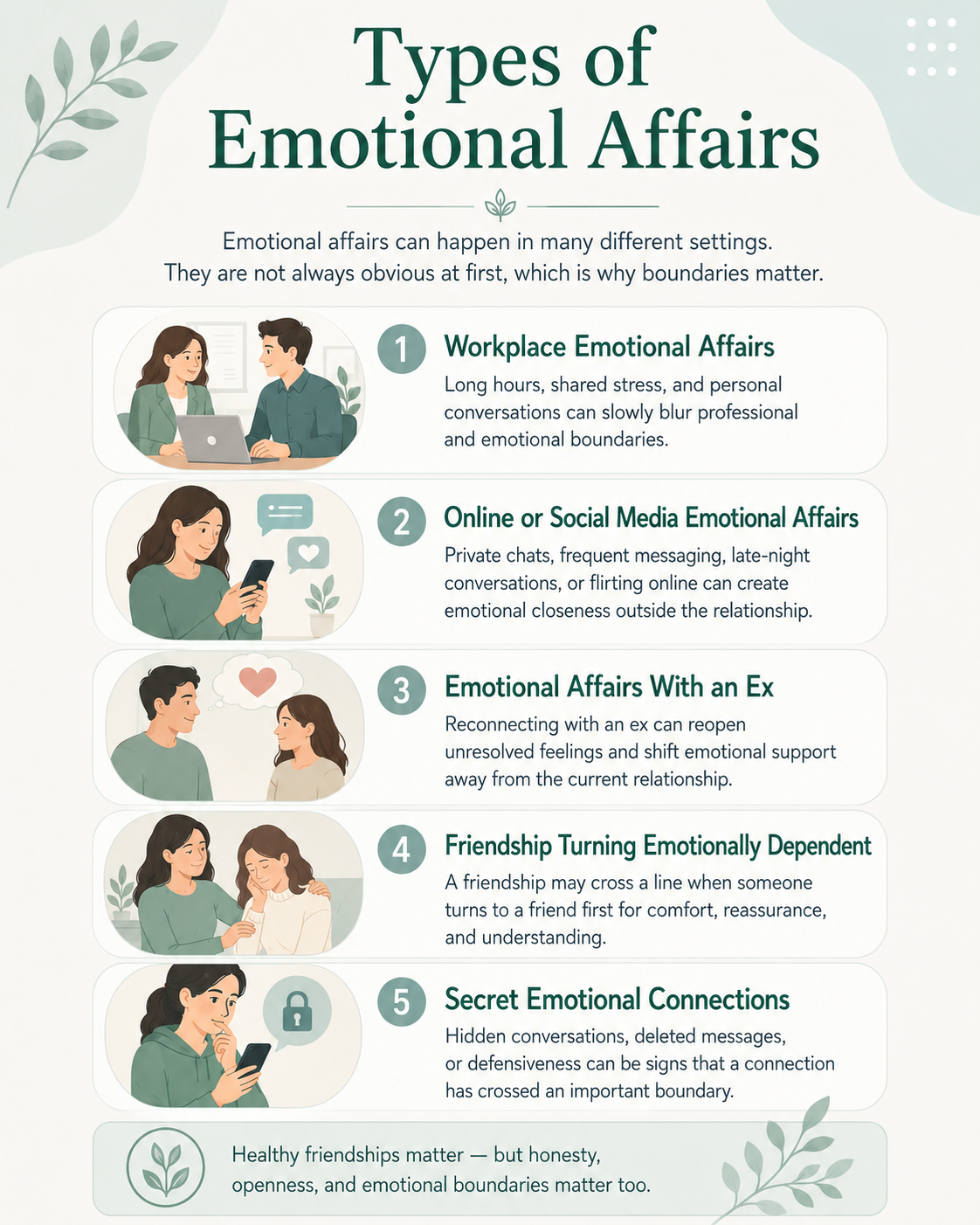
Common Types of Emotional Affairs
Emotional affairs can happen in many different settings. They are not always obvious at first, which is why boundaries matter.
- Workplace Emotional Affairs
Workplace affairs are common; colleagues spend long hours together, sharing stress and challenges. A friendship may start harmlessly but becomes intimate if one shares relationship problems, seeks comfort, or hides the closeness from their partner.
- Online or Social Media Emotional Affairs
Online chats can create closeness quickly. Frequent messaging, late-night talks, flirting, or sharing feelings privately can lead to an emotional bond outside the relationship. Digital connections may seem trivial, but their impact can be significant.
- Emotional Affairs With an Ex
Reconnecting with an ex can bring comfort and unresolved feelings. Even without physical intent, relying on an ex for support can cause confusion and insecurity in the current relationship.
- Friendship Turning Emotionally Dependent
Friendships are generally healthy, but sometimes they become emotionally dependent. This occurs when one shares everything first with a friend, seeks reassurance from them, or feels more understood by them than their partner.
- Secret Emotional Connections
Some emotional affairs are defined by secrecy. If conversations are hidden, deleted, minimised, or defended aggressively, it may show that the connection has crossed a boundary.
Signs of an Emotional Affair
Recognising emotional affairs is hard because they often exist in grey areas, but certain patterns suggest boundaries have been crossed.
Common signs include:
- Hiding conversations or deleting messages
- Becoming emotionally withdrawn from the partner
- Feeling excited to talk to one specific person
- Sharing relationship problems with that person instead of the partner
- Becoming defensive when asked about the connection
- Comparing the partner emotionally to someone else
- Spending more time texting or confiding in another person
- Feeling guilty but continuing the connection
- Keeping the relationship secret or downplaying its importance
If You Think You May Be Emotionally Attached to Someone Else
Sometimes, the person involved in an emotional affair did not mean to hurt their partner. The connection may have started during a lonely, stressful, or emotionally difficult time.
You may have felt heard, appreciated, understood, or comforted in a way you did not feel in your relationship. You may have told yourself it was harmless since nothing physical happened.
But intention does not erase impact.
If you find yourself emotionally attached to someone outside your relationship, pause and reflect honestly. Are you sharing things with this person that you avoid sharing with your partner? Are you hiding or minimising the connection? Do you feel emotionally dependent on them? Do you compare your partner to them?
These questions are not meant to create shame. They are meant to create awareness. Emotional affairs often point to unmet needs, unresolved conflict, loneliness, or difficulty being vulnerable within the relationship.
How to Confront Your Partner About Emotional Cheating
Talking about emotional cheating can feel frightening. You may feel hurt, angry, confused, or anxious. While these emotions are understandable, staying calm can help make the conversation more productive.
Start by focusing on your feelings, not accusations. Instead of saying, “You cheated on me,” you might say, “I feel hurt and disconnected when I see how emotionally close you are with this person, especially when I feel shut out.”
Try to talk when both of you are calm, not during an argument. Be honest about what you noticed, how it affected you, and what you need to feel emotionally safe again.
You may want to discuss:
- What boundaries were crossed
- Why did the emotional connection develop
- What emotional needs may have been unmet
- What transparency is needed now
- How trust can be rebuilt
- Whether the outside connection needs to change or end
Avoiding blame does not mean ignoring the hurt. It means creating a space where both partners can speak honestly. This helps prevent the conversation from becoming only defensive or aggressive.
Rebuilding Trust After an Emotional Affair
Rebuilding trust after emotional infidelity takes time. It cannot be fixed through one apology or one conversation. Trust is rebuilt through consistency, honesty, and emotional accountability.
The hurt partner may need time to ask questions, express pain, and understand what happened. The partner who crossed the boundary may need to stay present, avoid becoming defensive, and acknowledge the impact of their actions—even if they did not intend to cause harm.
Rebuilding trust may involve clearer boundaries and more transparency. Honest conversations about emotional needs and a renewed effort to rebuild emotional intimacy are key in the relationship.
Both partners may also need to understand what made the relationship vulnerable to this situation. This does not mean blaming the hurt partner. It means looking at the emotional patterns, disconnection, or unresolved pain that may need attention.
Healing is possible, but it requires patience, honesty, and a willingness to repair.
How Therapy or Counselling Can Help
Emotional affairs often point to deeper relationship struggles: emotional distance, unmet needs, unresolved conflict, loneliness, poor communication, or difficulty expressing vulnerability.
Couples counselling can help partners understand what happened without turning the conversation into shame or blame. A counsellor or therapist can help both individuals explore the emotional patterns that led to the affair and support them in rebuilding trust.
Therapy can help with:
- Identifying unmet emotional needs
- Understanding why emotional support was sought outside the relationship
- Rebuilding communication and emotional intimacy
- Creating healthier relationship boundaries
- Managing anger, grief, guilt, or insecurity
- Resolving conflict in a safer way
- Rebuilding trust after emotional infidelity
Individual counselling can also help if one partner is struggling with guilt, confusion, attachment, or emotional dependency. For the hurt partner, therapy can provide space to process betrayal, rebuild self-worth, and decide what healing looks like.
Emotional healing takes time. There may be difficult conversations, setbacks, and uncomfortable emotions. But with honesty, willingness, and support, many couples can rebuild a stronger, more emotionally aware relationship.
Moving Forward With Clarity and Care
Emotional affairs can leave both partners feeling confused, hurt, defensive, or unsure of what to do next. One partner may be struggling with guilt or emotional dependency, while the other may be dealing with betrayal, insecurity, or broken trust.
At Incontact Counselling, therapy provides a safe and supportive space to understand what led to the emotional disconnection and how both partners can move forward with more clarity. Through individual or couples counselling, you can explore unmet emotional needs, rebuild communication, set healthier boundaries, and work through relationship trust issues at a pace that feels safe.
Counselling is not about blaming one person. It is about understanding the emotional patterns that may have affected the relationship and learning healthier ways to reconnect, communicate, and heal.
If emotional cheating, emotional distance, or trust issues are affecting your relationship, Incontact Counselling can help you rebuild communication, clarity, and emotional intimacy.
Submit a Comment
Your email address will not be published. Required fields are marked *
Recent Blogs

Mental Health, Stress & Burnout
When Achievement Doesn’t Feel Like Enough
17 September, 2026
Achievements may stop feeling satisfying when self-worth becomes closely tied to performance, recognition, productivity, or meeting expectations. Instead o...

Mental Health, Stress & Burnout
Digital Burnout: Signs You Need a Break
7 September, 2026
Many of us spend much of our day online. We check messages when we wake up, reply to emails at work, scroll through social media during breaks, use screens...

Overcoming Negative Thought Patterns
27 August, 2026
All of us experience negative thoughts from time to time. We may think, “I’m not good enough,” “I always mess things up,” “Nobody really cares,...

