Why Do I Keep Overthinking Everything?
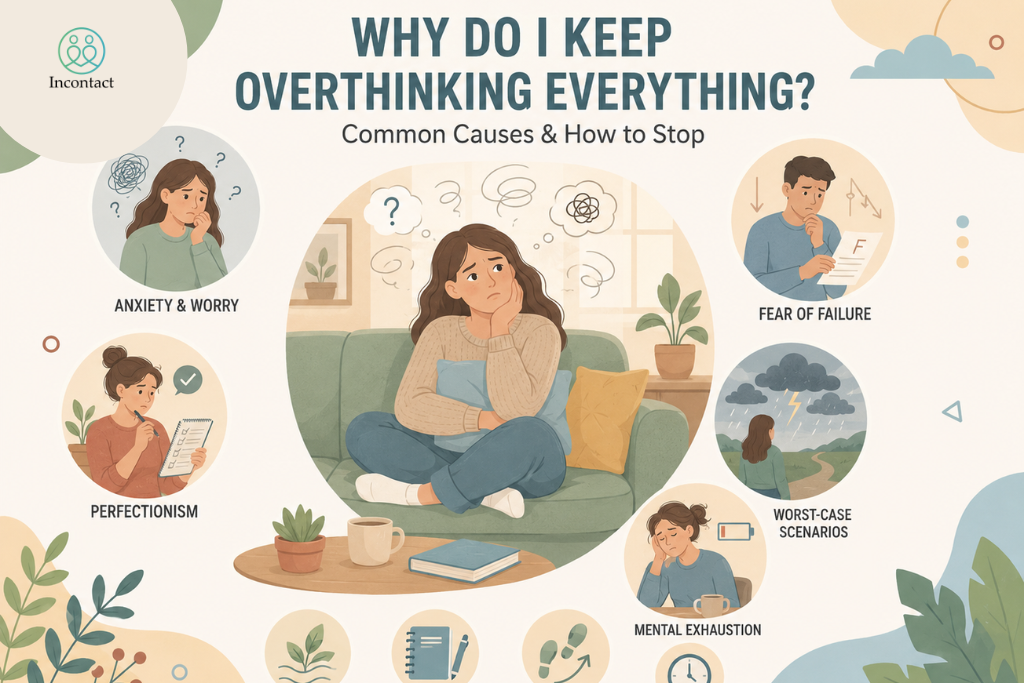
Overthinking is mentally exhausting. You may replay conversations, second-guess decisions, or imagine worst-case scenarios, struggling to switch your mind off. Many experience this during anxiety, stress, uncertainty, or self-doubt. While common, overthinking can overwhelm sleep, relationships, work, or emotional health. These mental loops can make simple situations heavier, and searching for certainty may leave you unsettled. Understanding why overthinking occurs is the first step to managing it with clarity and compassion.
What Is Overthinking?
Now that we’ve explored why overthinking happens, let’s clarify what overthinking actually means.
Overthinking is the habit of repeatedly thinking about something without reaching a helpful conclusion. It may involve analysing the past, worrying about the future, or questioning your choices over and over.
Of course, not all deep thinking is overthinking. When you face a major decision, such as choosing a university, switching careers, getting married, or going through a divorce, it is natural to think carefully about the possible outcomes. Major life changes often require reflection, planning, and thoughtful consideration.
Overthinking is unhelpful when your thoughts no longer lead to decisions or progress, but instead keep circling similar fears, doubts, or questions without clarity.
Overthinking generally falls into two categories:
Rumination: Fixating on past mistakes, previous conversations, or events that have already happened.
Worrying: Thinking ahead into the future and becoming caught up in worst-case scenarios or “what if” situations.
Common Reasons You May Be Overthinking
Overthinking can happen for many reasons. It does not mean something is wrong with you. It often means your mind is under pressure.
Anxiety and worry
Anxiety and overthinking often go together. Anxiety makes the mind scan for possible danger, while overthinking tries to predict or prevent that danger. This can create a loop where one worry leads to another.
For example, a small mistake at work may lead to “What if my manager thinks I am careless?” and then “What if this affects my future?”
Perfectionism
If you feel pressure to do everything correctly, decisions can become stressful. You may worry about saying the right thing, choosing the best option, or avoiding criticism. Perfectionism can make ordinary choices seem larger than they are.
Fear of failure
Overthinking may arise from trying to avoid regret. Reviewing every possible outcome can make decisions feel frightening and lead to mental fatigue, making even small choices tiring.
Need for control
Uncertainty can feel uncomfortable. When life seems unpredictable, your mind may try to regain control by planning, analysing, or preparing for every outcome. However, not everything can be solved through thought.
Low self-confidence
If you often doubt yourself, you may seek reassurance before making decisions, ask others for opinions repeatedly, or check if you did the “right” thing.
Stressful life events
Major changes such as relationship problems, work, family conflict, financial worries, or health concerns can increase overthinking. When your nervous system is stressed, your thoughts may speed up and become harder to manage.
How Overthinking Affects Mental Health
Overthinking drains mental energy and locks your brain into stressful loops, making you more vulnerable to anxiety, depression, and burnout. It shifts focus toward negative ‘what-if’ scenarios, making relaxation or decision-making difficult.
Chronic overthinking impacts mental health by creating the following destructive patterns:
- Increased Anxiety and Stress
- Heightened Risk of Depression
- Brain Fog and Mental Exhaustion
- Sleep Disturbances
- Strained Relationships
How to Stop Overthinking
Breaking overthinking habits requires training your brain to interrupt circular thought loops. Techniques like physical grounding, actionable problem-solving, and postponing worries to a set time help you regain control over your attention.
Actionable strategies to break the overthinking cycle include:
- Schedule “Worry Time”: Instead of letting thoughts consume your day, set aside a specific 15-30 minute window in the early evening. When trigger thoughts occur earlier, tell yourself, “I’ll deal with this later,” and defer them to your scheduled time.
- Try the 5-4-3-2-1 Grounding Technique: When your brain spirals, bring yourself into the present moment by naming out loud: 5 things you can see, 4 things you can touch or feel, 3 things you can hear, 2 things you can smell, and 1 thing you can taste.
- Write It Down: Overthinking thrives in the mind. Transfer your worries, doubts, and decisions onto paper. Identify one actionable step you can take and commit to moving forward.
- Shift to Action: Ask yourself: “Is there anything I can do about this situation right now?” If yes, take brief action and stop further thought. If not, accept the reality and refocus your energy on an engaging hobby or physical exercise.
- Change Your Environment: If your mind is stuck in a loop, interrupt it. Take a brief walk, do some stretching, or change rooms to shift your mental perspective.
When Should You Seek Professional Help?
Sometimes, overthinking may require additional support. So, when is it time to seek professional help?
Counselling may be helpful when overthinking starts affecting your daily life, relationships, sleep, work, or overall well-being.
You may benefit from professional mental health support if you feel unable to control your worries, avoid decisions because of fear, need constant reassurance, or feel mentally exhausted most days.
Therapy can help you understand the causes of overthinking and identify unhelpful thought patterns. A counsellor may support you in exploring anxiety, perfectionism, self-doubt, relationship triggers, or past experiences that contribute to rumination.
Approaches such as cognitive behavioural therapy, mindfulness-based strategies, stress management, and self-compassion can help you build healthier coping skills.
Conclusion
Overthinking is common, especially during anxiety, stress, uncertainty, or self-doubt. It often begins as an attempt to protect yourself, but it can become exhausting when it keeps you stuck in a cycle of repeated thoughts.
The good news is that overthinking can be managed. Challenging negative thoughts, setting decision limits, practising mindfulness, journaling, reducing information overload, and focusing on what you can control can all help.
You do not have to manage it alone. With the right support, you can understand your thought patterns and build a calmer, healthier relationship with your mind.
If overthinking is affecting your daily life, relationships, sleep, or wellbeing, Incontact Counselling can help. Our experienced counsellors provide a supportive space to understand your thoughts, manage anxiety, and build healthier coping strategies. Contact us today to learn more.
Submit a Comment
Your email address will not be published. Required fields are marked *
Frequently Asked Questions
You may struggle to stop overthinking because your mind is seeking certainty, safety, or control. When something feels unresolved or emotionally important, your brain may keep replaying it. Stress, anxiety, perfectionism, and self-doubt can make this pattern stronger.
Overthinking can be linked to anxiety, but it does not always mean you have an anxiety disorder. Many people overthink during stressful periods. However, if your worries feel constant, difficult to control, or interfere with daily life, counselling for anxiety may be helpful.
Yes, overthinking can affect sleep. Many people find that worries become louder at night when the mind has fewer distractions. Replaying conversations, planning excessively, or imagining worst-case scenarios can make it harder to relax and fall asleep.
Worry usually focuses on future problems, while overthinking can include both future worries and past events. Overthinking often involves replaying, analysing, or second-guessing without reaching a useful outcome. Both can overlap and become tiring when they feel repetitive.
Yes, counselling can help you understand why overthinking happens and how to manage it. A counsellor can support you in identifying negative thought patterns, practising CBT techniques, managing anxiety, and building healthier ways to respond to stress and uncertainty.
Recent Blogs
The Silent Distance in Sibling Relationships
22 June, 2026
Sometimes, the distance between siblings does not begin with a fight. It begins quietly. A missed call. A shorter reply. A family gathering where conversat...
Emotional Affairs: Understanding Emotional Cheating and Its Impact on Relationships
19 June, 2026
Not all betrayal starts with physical intimacy. Distance in a relationship can begin quietly through secret conversations, emotional dependence, frequent t...

Postpartum Intimacy: Navigating Changes in Your Body, Mind, and Relationship After Childbirth
21 May, 2026
You’ve just experienced one of the most intense challenges your body endures. You are healing, adjusting, and learning to care for a new life. Amid sleep...

